
We’ve all seen the promises. Whiter teeth in seven days. A brighter smile after just a few brushes. Years of stains removed with nothing more than a tube of toothpaste. But how much of this is actually true?
Walk down the toothpaste aisle of almost any supermarket and you’ll find dozens of products promising a whiter, brighter smile. Some contain hydrogen peroxide, others advertise charcoal, and a few claim to use advanced colour-correcting technology.
With so many options, it’s hardly surprising that people are confused about what whitening toothpaste can realistically achieve.
The good news? Whitening toothpaste isn’t just a marketing gimmick. There is genuine scientific evidence that it works.
The catch is that removing stains and actually whitening your teeth are two very different things.
Let’s look at what whitening toothpaste really does, which ingredients matter, and whether it’s worth spending extra money on.
First, Why Do Our Teeth Become Yellow?
Before we talk about whitening toothpaste, it helps to understand why teeth lose their brightness in the first place.
Despite what social media might suggest, perfectly white teeth aren’t necessarily natural. Healthy teeth come in a range of shades, from creamy white to slightly yellow.
Your natural tooth colour is partly determined by dentine, the layer beneath your enamel. Dentine has a naturally yellowish appearance, while enamel is relatively translucent.
As we age, enamel can become thinner, making the underlying dentine more visible. That’s one reason teeth often appear darker as we get older.
But ageing isn’t the only culprit.
Coffee, tea, red wine and tobacco can all leave pigments on the surface of our teeth. Over time, these stains accumulate, gradually dulling an otherwise healthy smile.
Dentists generally divide tooth discolouration into two categories:
- Extrinsic staining: Discolouration on the outside of teeth, often caused by food, drinks and tobacco.
- Intrinsic discolouration: Changes within the tooth structure, associated with ageing, tooth development, certain medications or dental trauma.
This distinction matters because whitening toothpaste is considerably better at tackling the first type than the second.
According to the American Dental Association, whitening toothpastes primarily work by removing external stains rather than significantly changing the underlying colour of teeth.
So, Does Whitening Toothpaste Actually Work?
The short answer is yes. But probably not in the way you imagine.
Whitening toothpaste can help remove stains that have built up on your enamel, making your teeth appear cleaner and brighter.
Imagine spilling coffee onto a white kitchen worktop. If the coffee leaves a brown mark, cleaning the surface restores its original appearance. It doesn’t make the worktop any whiter than it was before.
Whitening toothpaste works in a similar way.
It removes some of the discolouration sitting on the outside of your teeth, revealing more of their natural colour.
And this isn’t just a theory.
A 2025 systematic review and meta-analysis published in BMC Oral Health examined 14 randomised controlled trials comparing whitening toothpastes with regular toothpastes.
The researchers found that whitening toothpastes were more effective at reducing both the extent and intensity of external tooth staining.
However, the studies varied considerably in their methods and results, meaning further research is needed to understand the long-term benefits.
You can read the research here: Effect of Whitening Dentifrice on Discoloration of Tooth Surface – BMC Oral Health (2025).
In other words, whitening toothpaste does work. Just don’t expect it to transform naturally yellow teeth into a Hollywood smile.
What’s Actually Inside Whitening Toothpaste?
Not all whitening toothpastes work in the same way. In fact, two products sitting next to each other on a supermarket shelf might use completely different approaches.
1. Mild Abrasives: The Stain Removers
Most whitening toothpastes contain mild polishing ingredients, such as hydrated silica or calcium carbonate.
These help lift surface stains as you brush.
Think of them as tiny cleaning particles that gently polish the enamel, removing some of the pigments left behind by food and drinks.
They’re particularly useful for people who regularly drink coffee or tea.
However, more abrasive doesn’t automatically mean better. A well-formulated toothpaste should balance stain removal with protecting the tooth surface.
2. Hydrogen Peroxide: The Whitening Ingredient
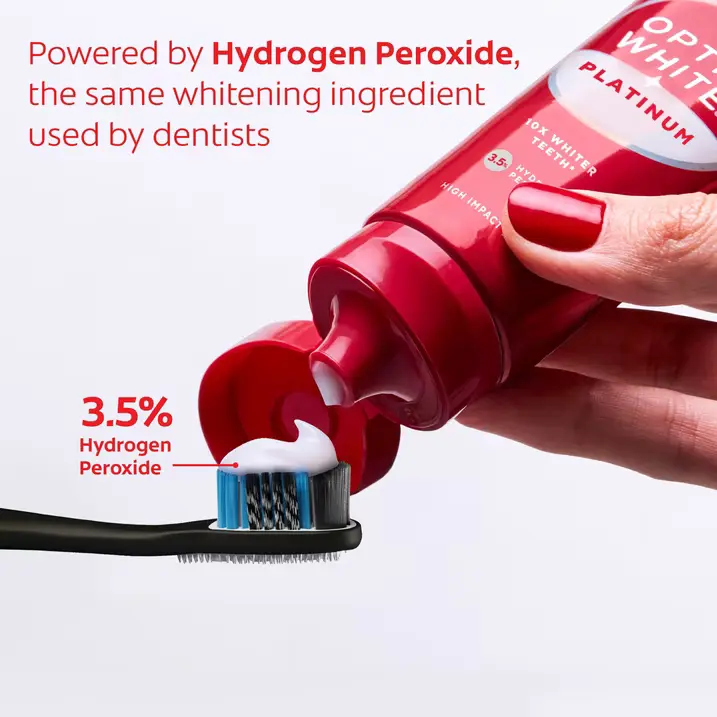
Hydrogen peroxide is one of the most widely recognised ingredients in teeth whitening.
Unlike polishing agents, which primarily remove surface stains, hydrogen peroxide works through a chemical process that breaks down coloured compounds.
It’s also an ingredient used in many professional teeth whitening treatments.
So why doesn’t peroxide toothpaste deliver the same results?
The biggest difference is contact time.
When you brush your teeth, the toothpaste is generally in contact with your enamel for around two minutes before being spat out.
Professional whitening treatments typically keep peroxide in contact with the teeth for much longer, using carefully controlled concentrations and application methods.
Some peroxide-containing toothpastes can produce additional whitening effects, but results depend on the formulation and how it’s used.
3. Optical Brighteners: The Instant Effect
Ever wondered how some toothpastes promise visibly whiter teeth after a single brush?
Certain products use optical ingredients, such as blue covarine, which can temporarily change how light reflects from the teeth.
The result is a subtle visual effect that can make teeth appear less yellow.
It’s a clever approach, but the effect is temporary and doesn’t necessarily mean any deep staining has been removed.
How Long Does Whitening Toothpaste Take to Work?
This is where patience comes in.
Although some toothpastes advertise immediate results, meaningful stain removal generally takes consistent use.
Many clinical studies assess whitening toothpaste over periods of approximately two to six weeks.
If you brush twice daily, you may gradually notice that your teeth look cleaner, particularly if you have staining from tea, coffee or red wine.
But results vary considerably.
Someone with heavy surface staining may see a more noticeable improvement than someone whose teeth are naturally yellow.
And if you’ve already got relatively stain-free teeth, whitening toothpaste might make very little visible difference.
The important thing is to keep expectations realistic. A toothpaste isn’t going to deliver the same dramatic results as a dedicated whitening treatment.
Whitening Toothpaste vs Whitening Strips: Which Is Better?
Here’s where things become interesting.
Whitening toothpaste and whitening strips are often advertised as competing products, but they generally serve different purposes.
Whitening toothpaste is primarily designed for everyday cleaning and stain removal.
Whitening strips, on the other hand, commonly use peroxide-based formulas that remain against the teeth for a longer period.
That extended contact allows the whitening ingredients to work beyond ordinary surface polishing.
A 2020 systematic review published in Operative Dentistry compared whitening toothpastes with other whitening products.
The researchers found that whitening strips produced greater whitening effects than whitening toothpastes in the studies examined, although the overall quality of evidence ranged from low to moderate.
So which should you choose?
If your main concern is everyday staining, whitening toothpaste may be perfectly adequate.
If you’re looking for a more noticeable change in the natural shade of your teeth, a dentist-supervised peroxide whitening treatment is likely to be more effective.
For many people, the two approaches can complement each other: a suitable toothpaste for daily cleaning and stain management, alongside professional whitening when appropriate.
Are Whitening Toothpastes Safe for Your Enamel?
One of the biggest concerns surrounding whitening toothpaste is whether regular use can damage enamel.
The reassuring news is that many reputable whitening toothpastes are formulated for everyday brushing.
However, not all products are equal.
Some whitening formulas rely more heavily on abrasive ingredients, and brushing too aggressively can contribute to enamel wear and gum recession.
This is particularly important if you already experience tooth sensitivity or have exposed root surfaces.
A few simple habits can help protect your teeth:
- Choose a fluoride-containing toothpaste suitable for daily use.
- Brush gently with a soft-bristled toothbrush.
- Avoid scrubbing harder in an attempt to remove stains faster.
- Be cautious with highly abrasive DIY whitening methods.
- Speak to your dentist if whitening products cause persistent sensitivity or irritation.
Charcoal toothpaste deserves a special mention here.
Although charcoal products have become popular on social media, their whitening claims shouldn’t automatically be taken at face value. Evidence for meaningful bleaching benefits is limited, and some formulations may be unnecessarily abrasive.
Remember, enamel doesn’t grow back once it’s lost. Protecting your teeth should always come before chasing a brighter shade.
Can Whitening Toothpaste Remove Years of Coffee and Tea Stains?
Possibly, but it depends on how deeply the staining has developed.
If your teeth have gradually become discoloured from drinking coffee every morning, a whitening toothpaste may help reduce some of those stains.
However, stubborn staining that’s been building up for years may require a professional clean.
A dental hygienist can remove plaque, hardened tartar and certain surface stains that ordinary brushing cannot.
It’s also worth remembering that not every yellow-looking tooth is stained.
If the colour comes from the underlying dentine rather than external pigments, no amount of polishing will dramatically change it.
That’s when professional advice about whitening options becomes more useful.
What About Purple Whitening Toothpaste?
Purple toothpaste has attracted plenty of attention online, largely because of dramatic before-and-after videos.
The idea is based on colour correction.
Purple sits opposite yellow on the colour wheel, so purple pigments can temporarily neutralise some yellow tones in the way teeth appear.
It’s a similar principle to purple shampoo, which is used to counteract yellow tones in blonde hair.
But there’s an important difference between making teeth look whiter and actually changing their colour.
Purple toothpaste doesn’t necessarily remove deep stains or chemically bleach teeth.
Any immediate visual improvement may be temporary, and results vary between products.
It’s an interesting cosmetic option, but it shouldn’t be confused with conventional peroxide-based whitening.
Is Expensive Whitening Toothpaste Worth the Money?
Not necessarily.
A higher price doesn’t automatically mean better whitening results.
Some premium toothpastes contain specialised stain-removing ingredients or peroxide-based formulas, but others rely heavily on branding, packaging and bold marketing claims.
Rather than choosing toothpaste based on the price tag, consider what you actually want to achieve.
If you’re trying to remove everyday surface stains, a reputable fluoride whitening toothpaste may be all you need.
If you’re hoping to change your natural tooth shade by several levels, spending more on toothpaste probably won’t deliver the transformation you’re expecting.
It’s also worth looking beyond whitening claims. A good everyday toothpaste should help protect against tooth decay, not simply promise cosmetic improvements.
The Best Way to Keep Your Teeth Looking White
The secret to a brighter smile isn’t necessarily buying the strongest whitening product available.
Often, it’s a combination of good oral hygiene, sensible habits and choosing the right treatment for your teeth.
Brushing twice daily with fluoride toothpaste helps remove plaque and prevent stains from building up.
Regular dental appointments can identify problems early, while professional cleaning may help remove stubborn surface deposits.
If you drink lots of coffee or tea, rinsing your mouth with water afterwards can help wash away some residue.
And if you’ve already had your teeth professionally whitened, a suitable whitening toothpaste can be a useful part of your maintenance routine.
However, whitening toothpaste alone cannot guarantee that professional whitening results will last indefinitely.
The Verdict: Is Whitening Toothpaste Worth Using?
Absolutely, provided you understand what you’re buying.
Whitening toothpaste isn’t a miracle product, but it isn’t a waste of money either.
Scientific research supports its ability to reduce external staining, and for many people, that alone can make a worthwhile difference to their smile.
Where whitening toothpaste falls short is in delivering substantial changes to the natural colour of teeth.
For that, peroxide-based treatments provided or supervised by a dental professional are generally more effective.
The bottom line? Whitening toothpaste is best thought of as a maintenance product rather than a complete teeth whitening treatment.
It can help keep your smile looking fresh, tackle everyday stains and support the results of other whitening treatments.
Just don’t expect two minutes of brushing to undo years of discolouration overnight.
Sometimes the simplest products do exactly what they’re supposed to do. The trick is knowing what that actually is.
Frequently Asked Questions
Does whitening toothpaste permanently whiten teeth?
No. Whitening toothpaste primarily removes surface stains rather than permanently changing the natural colour of your teeth. New stains can develop over time, particularly if you regularly consume strongly coloured foods and drinks.
Can I use whitening toothpaste every day?
Many whitening toothpastes are suitable for twice-daily use when used according to their instructions. Look for a fluoride-containing formula and speak to your dentist if you experience sensitivity or have concerns about enamel wear.
Does whitening toothpaste work on yellow teeth?
It depends on what’s causing the yellow appearance. If it’s surface staining, whitening toothpaste may help. If your teeth are naturally yellow or the discolouration is internal, the improvement is likely to be limited.
Is hydrogen peroxide toothpaste better than regular whitening toothpaste?
Hydrogen peroxide can help break down coloured compounds, while many conventional whitening toothpastes rely mainly on polishing ingredients. However, the effectiveness of peroxide toothpaste depends on its formulation, concentration and contact time.
Can whitening toothpaste whiten crowns or veneers?
Whitening toothpaste may help remove some external stains from dental restorations, but it won’t change their underlying shade. Abrasive products can also affect certain restoration surfaces, so ask your dentist which toothpaste is appropriate.
References and Further Reading
- American Dental Association. Whitening. Explains the differences between intrinsic and extrinsic stains and reviews common whitening treatments.
https://www.ada.org/resources/ada-library/oral-health-topics/whitening - Hajisadeghi S. et al. (2025). Effect of Whitening Dentifrice on Discoloration of Tooth Surface: An Updated Systematic Review and Meta-analysis. BMC Oral Health.
https://doi.org/10.1186/s12903-025-05851-4 - Devila A. et al. (2020). Efficacy and Adverse Effects of Whitening Dentifrices Compared With Other Products: A Systematic Review and Meta-analysis. Operative Dentistry.
https://pubmed.ncbi.nlm.nih.gov/31738695/ - Soeteman G.D. et al. (2018). Whitening Dentifrice and Tooth Surface Discoloration: A Systematic Review and Meta-analysis. International Journal of Dental Hygiene.
https://pubmed.ncbi.nlm.nih.gov/28573755/ - NHS. Teeth Whitening. Patient guidance on whitening procedures, suitability and safety.
https://www.nhs.uk/tests-and-treatments/teeth-whitening/